

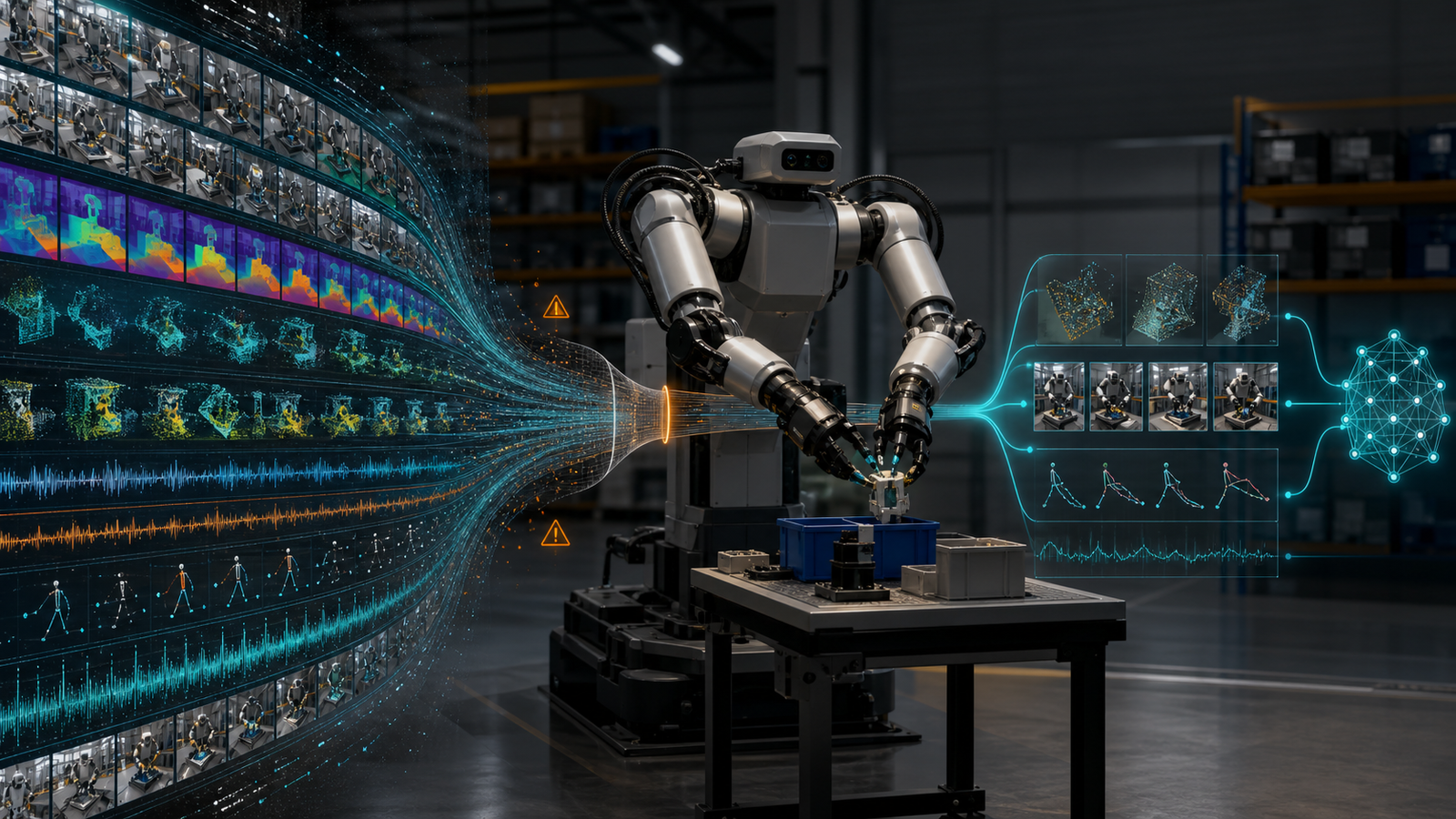
The embodied AI data bottleneck is not simply a shortage of recorded hours. It is a shortage of demonstrations that connect the right observation, instruction, robot state and action at the right moment—across enough objects, environments and failure conditions to support deployment. Teams that optimize only for episode count often discover the problem late: the dataset is large, but the model still fails when a camera moves, an object changes, or a gripper arrives a fraction of a second late.
Robotics has entered its “scale” era. Open X-Embodiment pooled data from 22 robot types. DROID contains 76,000 trajectories, 350 hours of interaction data and 564 scenes. RT-1 was trained on more than 130,000 real-world episodes spanning over 700 tasks. These projects prove that scale matters. They also show what “scale” actually means in robotics: not repetitions alone, but structured variation and a collection system capable of preserving it.
Robot data is not web data
A web image can remain useful after being detached from the camera that captured it. A robot demonstration cannot. Its meaning depends on coordinate frames, control frequency, action representation, gripper state, latency, calibration and the relationship between all sensor streams. Two videos that look identical to a reviewer may encode different actions. Two trajectories with the same instruction may teach incompatible motion styles.
This changes the economics of data. In embodied AI, an hour of collection has at least four possible outcomes:
- Training-ready: synchronized, correctly segmented, within specification and accompanied by complete metadata.
- Repairable: valuable but requiring re-alignment, relabeling or episode-boundary correction.
- Diagnostic: unsuitable as a positive demonstration but useful for understanding failures and recovery.
- Unusable: missing signals, invalid calibration, ambiguous task outcome or unsafe execution.
A program that reports only total hours hides this distribution. A better unit is accepted, coverage-increasing episodes.
A practical model of data utility
We use a simple conceptual model when scoping a collection program:
Data utility = task coverage × temporal integrity × embodiment fit × label consistency ÷ collection friction.
This is not a training metric. It is a decision tool. If any factor approaches zero, adding more hours rarely solves the underlying problem.
1. Task coverage
Coverage asks whether the dataset includes the situations the deployed system will actually face. That includes object geometry, material, clutter, lighting, camera placement, starting state, operator style and task outcome. A recent study of data scaling laws in robotic manipulation found that diversity of environments and objects mattered more than simply adding demonstrations after a per-condition threshold had been reached.
The procurement implication is straightforward: do not purchase “10,000 pick-and-place episodes” without defining the condition grid those episodes must fill.
2. Temporal integrity
Every frame needs a defensible relationship to the action and state attached to it. A small offset can turn the intended training pair—“see contact, then close”—into “see empty space, then close.” This is why synchronization is not merely infrastructure. It functions like a label embedded in every sample.
3. Embodiment fit
Human video, portable interfaces and robot teleoperation answer different questions. First-person video offers scalable human activity and rich semantic context. UMI-style collection captures manipulation trajectories without occupying the target robot. Direct teleoperation preserves the target embodiment and control stack. None is universally superior; the best choice follows the model objective and deployment constraints.
4. Label consistency
Language instructions should describe the same level of intent across episodes. Outcome labels need operational definitions. “Success” cannot mean “object moved” for one reviewer and “object placed within the target region without regrasping” for another. Inconsistent labels turn a physical learning problem into an avoidable supervision problem.
5. Collection friction
Robots are expensive, operators tire, environments reset slowly and hardware drifts. A specification that is theoretically perfect but impossible to execute consistently will not scale. Good program design reduces reset time, makes defects visible during collection and routes only ambiguous cases to expert review.
Why “perfect demonstrations only” is also a trap
Clean successful demonstrations are necessary, but a deployment distribution contains hesitation, partial progress, occlusion, slips and recovery. Behavioral cloning can drift into states the expert data never covered. The classic DAgger work formalized this distribution-shift problem: small policy errors compound when the learner visits unfamiliar states.
The answer is not to mix every failed episode into the positive set. It is to preserve failure context deliberately: what went wrong, whether the state was recoverable, what corrective action followed, and whether human intervention was required. Failure data becomes valuable when it is structured, not when it is dumped into the same bucket as expert demonstrations.
What to measure before buying more data
Before expanding volume, review five ratios:
- Acceptance rate: the share of captured episodes that pass the agreed specification.
- Coverage gain: the share that adds a new object, environment, initial state or failure condition.
- Repair rate: the share requiring manual synchronization, relabeling or boundary correction.
- Ambiguity rate: the share reviewers cannot classify without engineering input.
- Closed-loop value: the share collected in response to an observed model failure.
These numbers reveal whether the next budget should fund more collection, better instrumentation, a clearer task ontology or a targeted failure campaign.
The strategic shift: from data collection to data operations
The strongest embodied AI teams treat collection as a feedback system. The model exposes weak conditions. The data team converts those weaknesses into collection cells. QA checks both file integrity and task semantics. Dataset versions preserve lineage so experiments can be reproduced. The next collection round is driven by evidence, not by a generic target for hours.
This is the operating model behind MovraWorks’ custom multimodal data collection: define the training objective, instrument the capture, validate the streams, and expand only where new data changes model coverage. The result is not merely a larger dataset. It is a dataset whose value can be explained.
Questions buyers should ask
- What is the exact schema for observations, actions, state, language and timestamps?
- How are clocks synchronized and drift detected?
- Which variations are planned, and how is coverage reported?
- How are success, partial success, failure and intervention separated?
- Can every delivered episode be traced to its device, operator, task version and QA decision?
- What happens when model evaluation identifies a new long-tail failure?
The embodied AI data bottleneck will not be solved by treating physical experience as undifferentiated footage. It will be solved by building collection systems in which every additional episode has a reason to exist.