

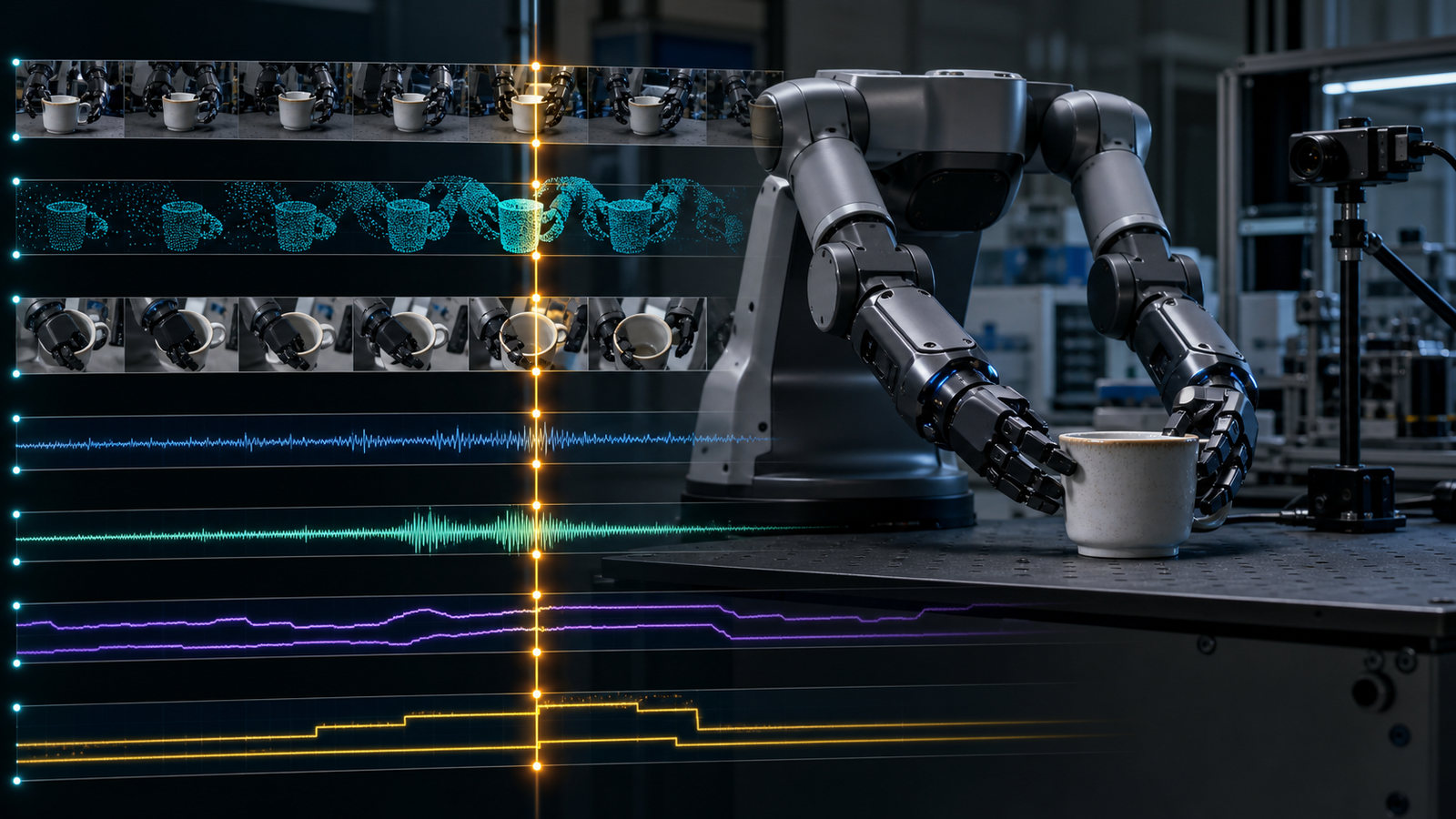
Multimodal synchronization is the process of placing video, depth, audio, IMU, robot state and action commands on one defensible timeline. In robot learning, synchronization acts like a hidden label: if the timing is wrong, the training pair is wrong even when every individual file looks valid.
Imagine a grasp episode. The wrist camera shows the fingers touching a cup. The gripper-state channel says “open.” The action channel says “close,” but it is attached to a frame captured 120 milliseconds earlier. A human reviewer may still recognize a successful grasp. A policy sees contradictory supervision.
Why small timing errors become learning errors
Robotic demonstrations are causal sequences. Perception precedes action; action changes state; state change appears in later observations. Misalignment distorts that chain in three ways:
- Premature actions: an action appears to occur before the visual condition that motivated it.
- Delayed actions: the model learns to wait after the relevant cue, creating sluggish or unstable control.
- False correlations: a state transition is paired with the wrong contact event, object pose or language segment.
The faster the task, the more expensive the error. Dynamic handoffs, tool use, pouring and bimanual coordination have narrow event windows. A fixed offset can be damaging; clock drift is worse because an alignment that looks correct at the start may fail later.
The six-clock audit
Before collection, list every clock that can create a timestamp:
- Sensor clock: the camera, IMU or tracker’s hardware time.
- Robot clock: controller time for joint state, end-effector state and gripper signals.
- Host clock: the computer receiving and saving messages.
- Network clock: arrival time after transport, buffering or wireless delay.
- Operator-interface clock: commands from a leader arm, VR controller or portable device.
- Annotation clock: the timeline used for event, language and outcome labels.
If a team cannot say which clock is authoritative and how the others relate to it, the dataset does not yet have a synchronization design.
Hardware sync, software sync and post-hoc alignment
Hardware synchronization
A shared trigger or timing signal is the strongest option when devices support it. It minimizes uncertainty at capture and is especially valuable for stereo, high-speed motion and multi-camera reconstruction. The limitation is operational: heterogeneous commercial devices do not always expose compatible trigger interfaces.
Software synchronization
Devices can share a clock through network time protocols or a host process. This is easier to deploy but must account for transport delay, buffering and timestamp location. “Timestamped on receipt” is not the same as “timestamped at exposure.”
Post-hoc alignment
When direct synchronization is unavailable, streams can be aligned using observable events: an LED flash, audio pulse, deliberate gripper motion, impact event or correlated motion in camera and IMU signals. Research on temporal calibration of heterogeneous robot sensors shows why time delay should be treated as a parameter to estimate, not an assumption.
Post-hoc alignment is useful, but it should be part of the protocol—not an emergency step invented after thousands of episodes have been recorded.
Store raw time before resampling
A common preprocessing mistake is to resample all streams to a target rate and discard original timestamps. This makes the files look tidy while erasing evidence needed to diagnose drift and missing frames.
Preserve at least:
- original device timestamp;
- host receive timestamp where available;
- frame or sample sequence number;
- clock domain and time unit;
- estimated offset and drift correction;
- resampling method and target rate;
- validity mask for interpolated or missing samples.
Standardized formats help downstream teams consume this information. LeRobotDataset v3, for example, provides unified access to multimodal time-series data, multi-camera video and metadata. A format alone does not guarantee alignment, but it gives the alignment decisions a stable place to live.
Synchronization QA should test events, not just files
File-level QA can confirm that a video opens and a state array has the expected length. It cannot prove that contact happened at the same time across streams. Add event-level tests:
- Start-of-session marker: a known visual, audio or motion event recorded by multiple devices.
- Mid-session marker: detects drift that a single initial marker cannot reveal.
- End-of-session marker: confirms total elapsed-time agreement.
- Cross-signal correlation: compare high-motion periods in video, IMU, joint velocity or controller commands.
- Semantic event review: sample grasp closure, release, contact, tool activation and other task-critical moments.
Report alignment as a distribution, not a promise. Median offset, high-percentile offset, drift per minute and the proportion of samples beyond tolerance are more informative than “streams are synchronized.”
Set tolerance from the task
There is no universal acceptable offset. A slow inspection task and a fast catch have different temporal bandwidths. Define tolerance by asking:
- How quickly can the relevant object state change?
- What is the policy action rate?
- How many frames form the model’s observation window?
- Which events are discontinuous—contact, release, trigger press or safety stop?
- Does the action representation predict a single command or a chunk?
A useful rule is to make synchronization error materially smaller than both the action interval and the shortest event the model must distinguish. The exact threshold should be validated by deliberately shifting a sample dataset and measuring downstream sensitivity.
Multi-view data raises the stakes
Synchronized first- and third-person capture can reveal what one view hides. The official Ego-Exo4D documentation describes time-synchronized egocentric and exocentric video. That design enables cross-view reasoning because the same action can be located on a shared timeline.
For robot data, the same principle applies to fixed scene cameras, wrist cameras, depth sensors and tactile signals. More views are useful only if the system preserves their temporal relationship. Otherwise, additional modalities increase storage faster than information.
What a synchronization deliverable should contain
A professional multimodal data collection delivery should include more than aligned arrays:
- a clock and timestamp specification;
- device-level calibration records;
- raw timestamps and transformed global time;
- per-episode sync diagnostics;
- missing-frame and interpolation masks;
- task-specific event checks;
- versioned preprocessing code or an equivalent transformation record.
Synchronization work is invisible when it is done well. That is precisely why it should be specified, measured and delivered as part of the dataset—not left as an undocumented assumption.