

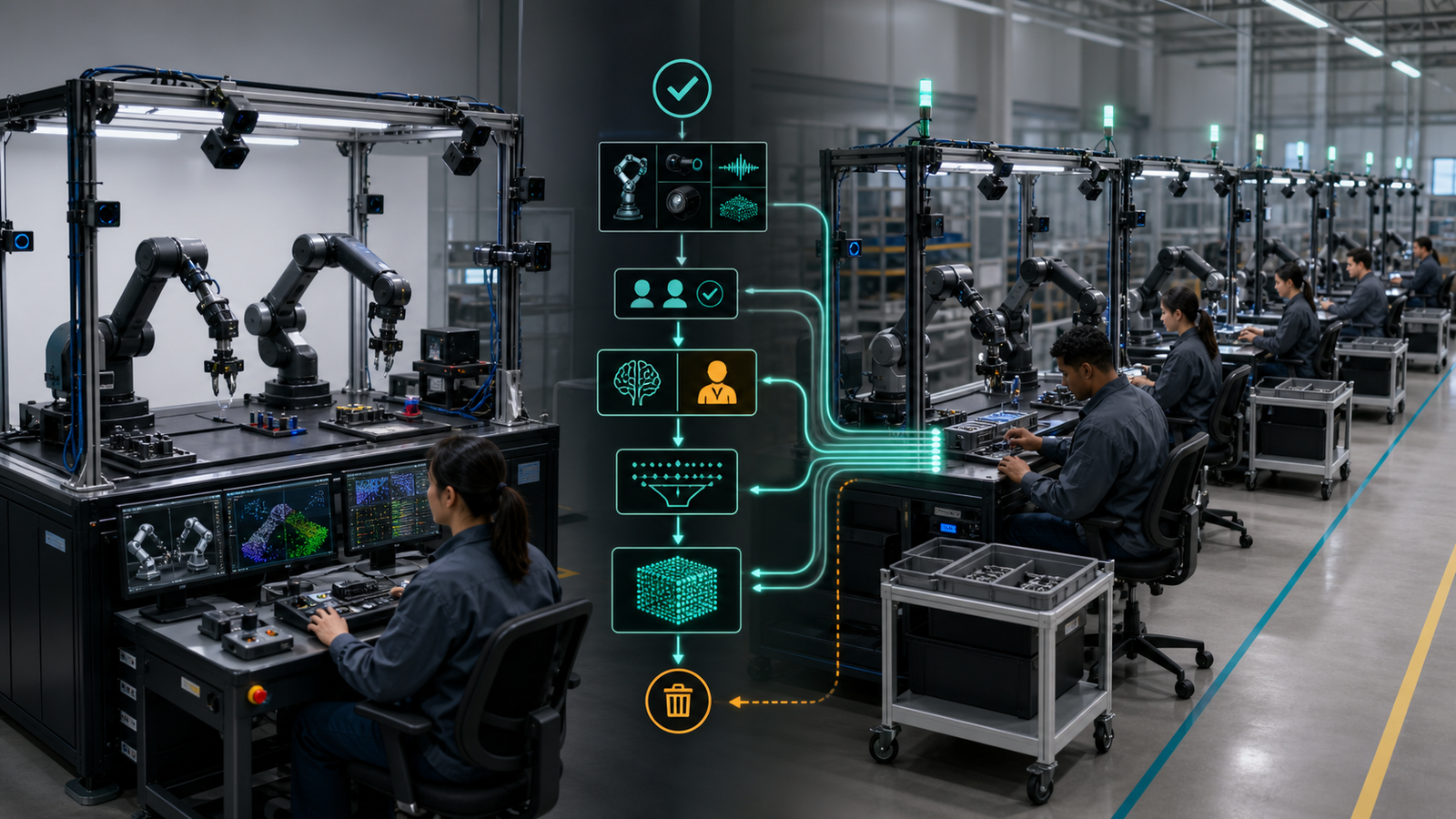
An embodied AI data pilot should prove five things before volume collection begins: the task has a measurable success definition, the collection interface captures the required signals, operators can execute the protocol consistently, the data passes automated and semantic QA, and the unit economics improve rather than collapse at scale.
A pilot is not a miniature production run. Its purpose is to reduce the uncertainties that would make production fail. A team that collects 500 polished episodes without testing synchronization drift, operator fatigue or coverage reporting may finish the pilot with the same risks it started with.
The SCOPE framework
Use five workstreams: Success, Collection, Operating envelope, Proof and Expansion.
S — Success definition
Write the task as an observable contract. Include:
- initial state and allowed variation;
- goal state and tolerance;
- time limit and termination conditions;
- permitted and prohibited strategies;
- collision, force and safety constraints;
- partial-success and failure definitions.
The success rule should be usable by an operator, a reviewer and—where possible—an automated evaluator. If those three interpret it differently, production metrics will not be trustworthy.
C — Collection interface
Select teleoperation, UMI-style or egocentric capture from the learning objective. Then define every channel:
- camera count, placement, resolution and frame rate;
- depth, IMU, audio, tactile or force signals;
- robot joint and end-effector state;
- action representation and control frequency;
- language instruction, subtask events and outcome labels;
- timestamps, clock source and calibration records.
Record a small engineering batch and replay it through the intended training loader. The pilot is incomplete if data exists only in the capture application.
O — Operating envelope
List the conditions that can change at deployment. Build a coverage matrix with priority weights. Include objects, layouts, lighting, camera pose, clutter, start state, operator and expected failure modes.
The goal is not to test every combination. It is to identify the variables with the highest probability and consequence. A clear matrix also prevents a common production pattern: collecting thousands of nearly identical episodes because they are easy.
P — Proof of quality
Define automated gates and human review before the first production shift. A practical acceptance plan covers:
- file and schema validation;
- timestamp and synchronization checks;
- signal ranges and coordinate conventions;
- task success and strategy compliance;
- episode boundaries;
- coverage assignment;
- reviewer agreement and escalation.
Run an intentional “bad batch” through the pipeline: remove frames, shift timestamps, mislabel outcomes and introduce boundary errors. A QA system that has never caught a known defect has not been validated.
E — Expansion logic
Specify what must be true before scaling. Good gates include:
- a stable acceptance rate across multiple shifts;
- no unresolved high-severity synchronization or calibration faults;
- operators reaching consistent throughput without quality decline;
- coverage reports matching the planned distribution;
- successful loading and baseline training on the delivered format;
- known cost per accepted episode and reset time;
- a documented process for model-driven recollection.
How many episodes should a pilot contain?
There is no universal number. The pilot must be large enough to expose variation across operators, sessions and environments, but small enough that the protocol can still change cheaply. Choose the count from the questions being tested.
For example, if the concern is multi-device clock drift, record long sessions with start, middle and end markers. If the concern is operator consistency, use multiple trained operators on the same task cells. If the concern is object generalization, spend episodes across object families rather than repeating one object.
Large research datasets illustrate different scaling dimensions. RT-1 collected more than 130,000 episodes over 17 months with a fleet of 13 robots. DROID distributed collection across 50 collectors and 564 scenes. The lesson for a pilot is not to imitate those counts; it is to validate the operating system that could eventually support the dimensions you need.
Track the economics that volume hides
Measure:
- setup and calibration time per shift;
- capture time and reset time per episode;
- accepted episodes per operator-hour;
- repair and expert-review minutes per episode;
- hardware downtime and fault recurrence;
- storage and transfer volume per accepted hour;
- coverage gained per one hundred episodes.
A process that doubles raw throughput but triples repair effort has not scaled.
Build a pilot dataset card
Document the pilot as if a different team will train on it six months later. Include motivation, composition, collection procedure, hardware, schema, QA, transformations, privacy and safety considerations, known limitations and intended uses. The Datasheets for Datasets approach provides a strong general foundation; robotics adds the need for control, calibration and embodiment details.
Common pilot failures
- Optimizing the demo: the best operator performs every episode, so production variability is never tested.
- Testing one day only: drift across shifts, recalibration and hardware wear remain invisible.
- Reviewing video only: action, state and timestamp defects pass unnoticed.
- No downstream loader: the schema is approved conceptually but fails in the training pipeline.
- No change budget: stakeholders expect pilot data to be final and resist correcting the protocol.
- Scaling on acceptance alone: quality is high, but coverage is concentrated in easy conditions.
What should exist at pilot completion?
- A signed task and data specification.
- A calibrated, repeatable capture workflow.
- A versioned schema with sample code or loader validation.
- An accepted dataset plus diagnostic and rejected partitions.
- A QA report and known-issues register.
- A coverage dashboard.
- Measured unit economics and production capacity.
- A scale plan with explicit stop conditions.
MovraWorks structures custom embodied AI data pilots around these outputs. The aim is not to make the pilot look impressive. It is to make the production decision defensible.
The most expensive dataset problem is not a defect discovered in the first fifty episodes. It is a defect discovered after fifty thousand. A well-designed pilot moves that discovery forward.